
Forward Head Posture: A Hidden Driver of Jaw and Neck Pain (TMJ/TMD)
Most people come to us with jaw pain, clicking, headaches or neck tension, often linked to TMJ disorder (TMD), and are surprised when we start talking about forward posture and how this affects the jaw.
But it’s not just the neck — it’s a whole-body pattern.
Through the body’s fascial connections, a shift in head position creates subtle adaptations all the way down, from the spine to the pelvis and into movement.
What Happens Through the Body with Forward Head Posture
When the head drifts forward, the body doesn’t just let it hang there - it reorganises underneath to keep you upright, eyes level, balanced, and looking ahead.
Neck (cervical spine)
The upper neck tips slightly backwards
The lower neck moves forward
Muscles at the back of the neck work harder to support the head
This often leads to stiffness, tension and fatigue.
Upper back and rib cage (thoracic spine)
The upper back becomes more rounded
The chest can collapse slightly
Shoulders drift forward and become rounded
This changes how the neck and jaw are supported.
Lower back (lumbar spine)
The natural curve may increase or sometimes flatten
Muscles begin to compensate for changes above
This can create a feeling of tightness or reduced support.
Pelvis
The pelvis often tilts (commonly forwards, but not always)
This alters how weight is transferred through the body
Core support can become less effective
Legs and movement
Weight distribution through the hips, knees and feet can shift
Walking patterns may subtly change
Some muscles become overworked while others do less
The Key Idea
These changes aren’t “wrong” — they’re your body adapting.
The issue isn’t posture itself, but staying in the same position for long periods without variation. Over time, certain areas become overworked while others switch off and that’s when discomfort or pain can start to show up, including in the jaw.
Why Does Forward Head Posture Happen?
It usually comes down to repetition.
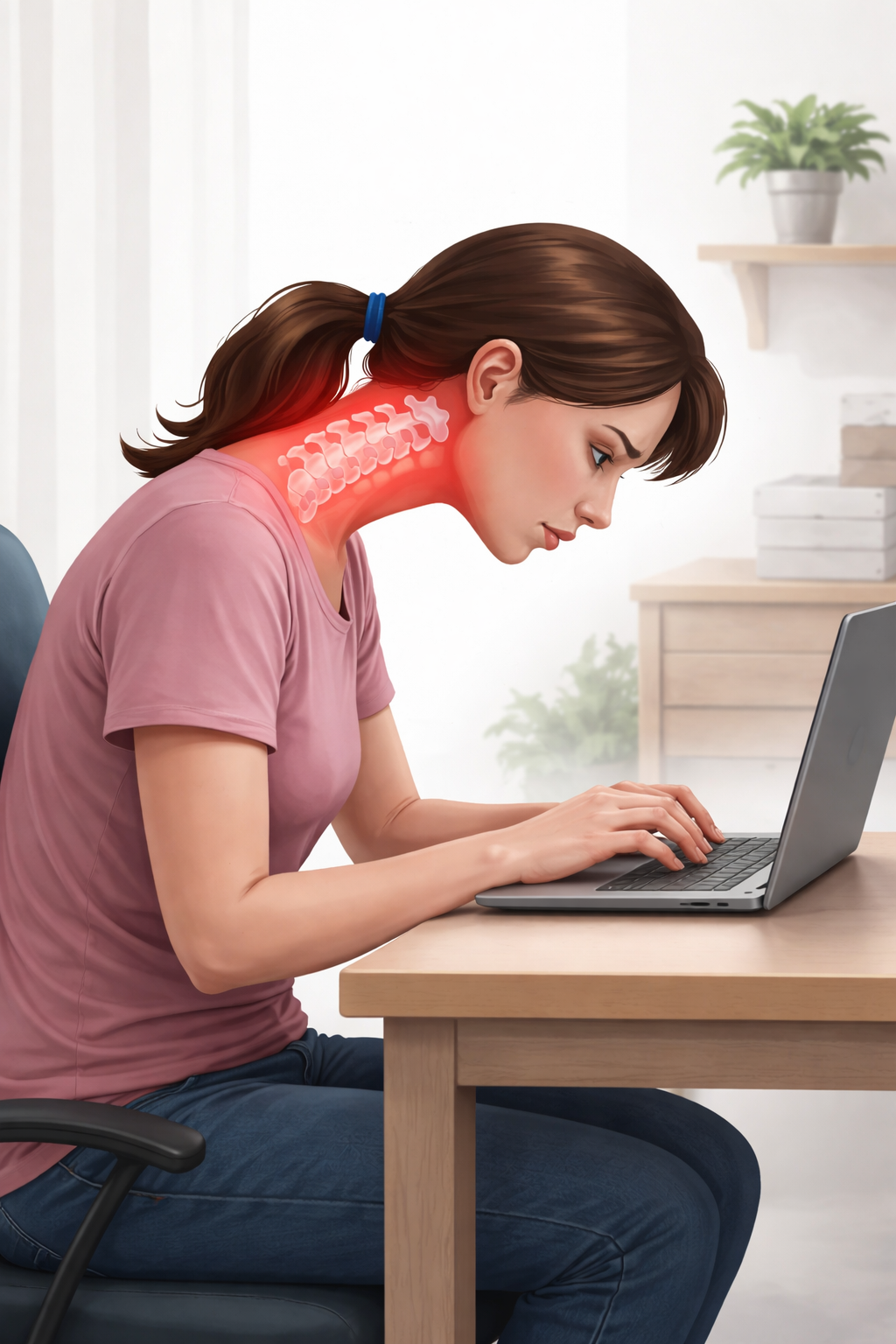
Think about how much of your day is spent with your head slightly forward:
laptop and desk work
phone use
driving
reading
knitting or crocheting
general day-to-day tasks
Everything pulls your attention forward — and your body follows.
We rarely move out of these positions.
This is why practices like yoga, stretching, massage and varied movement can feel so good — they simply take your body somewhere different.
So Where Does the Jaw Come In?
Your jaw doesn’t work in isolation.
The temporomandibular joint (TMJ) is closely linked to the neck through shared muscles and nerve pathways, which means changes in head and neck position can influence how the jaw feels and moves.
When the head sits forward over time:
the neck muscles work harder, fatigue and tighten
the jaw position moves backwards
the muscles around the jaw become overactive
clenching or grinding becomes more likely
This can show up as:
jaw pain or fatigue
clicking or popping
tension in the face or temples
headaches or migraines
difficulty eating harder or chewy foods
a feeling the jaw isn’t moving quite right
A Whole-Body Approach to TMJ Treatment
This is why, in our clinic, we don’t just look at the jaw.
We look at how your head sits on your spine, how your shoulders and back are working, how your pelvis is positioned, and how your body moves as a whole.
Because often, the jaw is only part of the story.
When tension is reduced and the body is supported more globally, the jaw often starts to settle more naturally.
How We Can Help
If you’re dealing with jaw pain, clicking, headaches or ongoing neck tension, a full-body assessment can help make sense of what’s really going on.
Treatment is gentle, tailored to you, and focused on restoring balance.
If you’d like to explore whether posture and movement patterns are contributing to your symptoms, you’re very welcome to get in touch or book a TMJ massage.
You might also be wondering
Is my jaw pain actually TMJ-related?
Not always — but it often is. Similar symptoms can also come from neck tension or muscle overload, which is why a full assessment helps clarify what’s driving your symptoms.
How many sessions will I realistically need?
This varies. Some people feel improvement within a few sessions, while longer-standing patterns take more time. You’ll be given a clearer idea after your first appointment.
Can TMJ treatment help with headaches or ear symptoms?
Yes, in many cases. The jaw, neck and head are closely connected, so reducing tension here can often ease headaches, facial pressure or ear-related symptoms.
What happens during a TMJ appointment?
We start with a consultation and assessment of your jaw, neck and posture, followed by gentle, targeted treatment based on what your body needs.